In the 19th and parts of the 20th centuries, orphans, abandoned children, runaways and children whose parents were too poor to take care of them ended up in orphanages. Orphanages were usually funded by public charities and provided orphans with a home, education, food and clothing.
If orphans were lucky, they were adopted by relatives or friends of their parents. If they were lucky, they would be treated respectfully. Most stayed in the orphanage, learning essential skills which would make them more employable in the outside world.
Upon adulthood, children were forced to leave the institution. Effectively, they became homeless.
It wasn’t until I started researching my family tree that I realised my great-grandmother Gertrude Mary Johnson had been placed in an institution at the age of 3. I was horrified. What had happened to necessitate her placement? My genealogical searches soon began to piece together a tragic picture.
Born in Islington, London, England to John Johnson and Mary Ann Freeman, Gertrude was the sixth daughter and seventh child (of nine). Her father was a ‘Seaman’ of some sort according to her baptism at St Mary the Boltons in Brompton at the age of 4. The family’s address was listed as Ifield Road.
Gertrude had a rough start to life. Her first entry in official records (apart from her birth registration) was on the admission list in 1884 for the Infirmary at St Mary’s Workhouse aged 3. Also listed were her siblings Lilly (12y), John “Jack” (10y), Mabel (7y) and Grace (5y). Notes by the Workhouse say: “Mother and one child admitted to House same time.” The one child would have been her younger brother George, just 1 year old. There was no entry for her father.
People ended-up in the workhouse for a variety of reasons. Usually, it was because they were too poor, old or ill to support themselves. In Gertrude’s case we will never exactly know. Census records can give an indication, however. In 1881, John’s occupation was Carriage Searcher. A Carriage Searcher would go on to the train after the passengers had alighted and look for belongings which might have been left behind. In any case, it was a menial job which didn’t pay a lot. Certainly not enough to support nine children.
Gertrude was again admitted to another Workhouse (Liverpool Rd) in September 1885. Records show she was admitted, aged 4, with her mother Mary Ann (36y), sister Grace (6y) and Annie (4mos). Gertrude’s brother George (2yrs at the time) is on record being admitted to the Marlesford Lodge School in August 1885. The admission record noted his mother’s name was Mary Anne and address 91 Adrian Terrace. According to the Survey of London, Adrian Terrace is now part of Ifield Road – tallying nicely with Gertrude’s address on her baptism record. Ifield Road was a particularly poor area of West Brompton in the late 1800s.
“A sprinkling of ‘run’, ‘gone’ and ‘excused’ in the ratebook for 1870 warns that Ifield Road was not the home of affluence, and the census of 1871 confirms this… In most streets nearby the average number of occupants per house seems roughly proportionate to the average size of the house but in Ifield Road the density of occupation is noticeable, with ten or eleven persons per house.”
‘The Boltons and Redcliffe Square area: The Gunter estate, 1864-78’, in Survey of London: Volume 41, Brompton, ed. F H W Sheppard (London, 1983), pp. 211-228. British History Online http://www.british-history.ac.uk/survey-london/vol41/pp211-228 [accessed April 2021].
Sadly, Mary Ann Freeman, Gertrude’s mother, died in 1889. Nine children now found themselves orphaned. Gertrude was certainly in an Orphanage until at least 1891 (Census records tell us that much), probably until around 1895/6 when she was 14 and able to leave for work. Older sisters Emily, Rose, Lily and Mabel, 24y, 22y, 19y and 14y in 1891 were fortunately old enough to be employed in service and support themselves. Brother Jack had run away in 1888, joining up at Aldershot in the British Army. Grace, George and Annie, 12y, 8y and 6y weren’t so fortunate, all were separated and sent to different homes, Gertrude in 1891 being at ‘The Orphanage’ in Dulwich, Camberwell, London; Grace an ‘inmate’ at the Holy Cross Home in Haywards Heath, Sussex; Annie an ‘inmate’ at another Holy Cross Home, Cuckfield, Sussex. George I have yet to place in 1891, but at 8 years old he was almost certainly in an institution of some kind.
Gertrude eventually emigrated to New Zealand in 1906, met and married Stanley Waltham Wilton in Palmerston North a year later and lived a happy life by all accounts, raising three children – John Stanley (Jack) Wilton, Phyllis Maud Wilton and my Grandmother Betty Joan Wilton.
So what happened to Gertrude’s father?
Our family branch – meaning the descendants of Jack, Phyllis, and Betty – believed John had probably run off with another woman, or died a pauper, or perhaps lived a dashing life on the sea with a woman in every port. I decided I had to find the truth if I could.
What did we know?
- An unbelievably unhelpful name: John Johnson – so far so common, almost impossible to find in the multitudes of John Johnsons in London, some from Scandinavia, some English natives.
- John married Mary Ann Freeman at St Luke, Chelsea in 1866. The marriage record noted John’s occupation as ‘Sea Faring’ and his address as 8 Bury St, Chelsea. His father Joseph John Johnson’s occupation was Furniture Dealer. The witnesses were William Freeman and Ann Johnson.
- There were rumours that Mary Ann Freeman had married beneath her. That could lend weight to the assumption that he had limited means and therefore could not keep the family together.
- His profession: Seaman?
- Gertrude had no contact with her father after 1889 – however, a cousin remembers a story told to her about Gertrude “seeing a man who looked a lot like him in the street in Wellington. She crossed the road to avoid him.” But Gertrude couldn’t have seen him in Wellington, could she? That was impossible, ridiculous, the chances that he would have run away and emigrated to New Zealand where Gertrude eventually ended up were next to none.
Starting at the beginning was the obvious step. My hope was that he would have a unique middle name, something to set him apart from the other John Johnsons in London. His marriage registration had confirmed a father and a possible sister, Ann Johnson.
Eventually I was able to determine that John had been born while his father Joseph was still married to another woman, Ann “Maria” Moore. Ann Johnson, one of the witnesses at his wedding to Mary Ann Freeman, was a half-sister. After Maria died (probably in the late 1840s), Joseph married Ann Nevill. I had been unable to find any record of John’s birth or baptism at that point and on a hunch searched the first/middle names Nevill and Johnson.
Immediately I was rewarded with a match: John Nevell Johnson, son of Joseph John Johnson and Ann, born 17 March 1844.

John’s baptism wasn’t until August 1847. This made perfect sense, possibly Maria had died by then and Joseph was able to present himself in church without too much comment. I was elated to finally have a middle name which distinguished him from all the other John Johnsons, Nevill, (the clerk at the church probably misspelt it as Nevell), his mother’s maiden name.
Finally I knew where John came from, and his full name: John Nevill Johnson. Now I just had to find out where he had disappeared to.
Fortunately, my mother had DNA tested with Ancestry.com and immediately, one match looked interesting. DW matched Mum with a predicted relationship 2nd – 3rd Cousin 2% shared DNA: 130 cM across 4 segments. He also shared matches with Mum’s brother, half-niece and nephew and other known cousins who descend from Gertrude Johnson’s sisters and brothers. The Shared cM Project 4.0 tool v4 showed DW and my mother had a 49% possiblity they were Half 2C, 2C1R, Half 1C2R and a 25% possibility they were Half 1C3R, 3C, Half 2C1R, 2C2R and a 14% possibility they were 2C Half 1C1R 1C2R.
I contacted DW and was interested to find out that DW’s grandmother Dorothy Ready had been born in Pancras, London in 1882. She had never known her father and lived much of her early life with her mother and half-brother in Workhouses before reaching leaving age, working as a Servant and emigrating to Canada in 1902. The parallels to my great-Grandmother’s life were immediate. Initially, we thought that John Nevill Johnson could have had a brother who fathered DW’s grandmother, but looking further into his family ruled that possibility out. We became certain that DW’s grandmother and my Mother’s grandmother had the same father. They were second cousins.
Not long after this, we found another DNA match, ‘meanim’ (pseudonym), who matched both DW, my mother and her known Johnson cousins. Meanim’s great-grandmother had turned out to be an NPE, she didn’t match any of her ‘paper’ father’s family. Born in 1879, in Islington, she also fit neatly into the time period that John Nevill Johnson had been in that area, born about the same time as Gertrude’s sister Grace. Probably, having been brought up by another man as his biological daughter, John Nevill Johnson may never even have known that he was father to this child.
So the plot thickened. I was no closer to finding out what had happened to John, but aspects of his life were becoming clearer. He clearly had no qualms about relationships outside of marriage, and felt little responsibility for the women he met.
A third DNA match, CD, appeared which I couldn’t place. CD matched Mum with 2% shared DNA: 115 cM across 5 segments. They also matched DW, ‘meanim’, Mum’s brother and her known Johnson cousins. A quick look at CD’s public tree showed they descended from an Elsie Johnson, born 1889. Elsie had married Charles Dyer in Wellington, New Zealand in 1908. On a hunch, I ordered the marriage printout, hoping to garner some more clues.
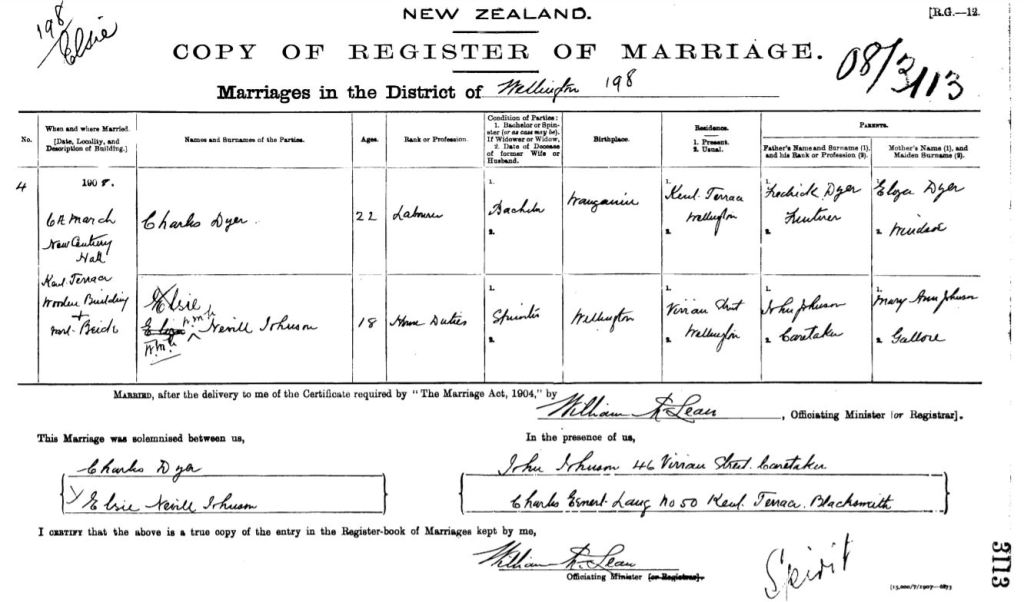
There it was: Elsie’s full name was Elsie Nevill Johnson. Her father, John Johnson, occupation Caretaker. Mother, Mary Ann Johnson nee Gallon. Even better, her father appeared to be a witness – with an address! 46 Vivian Street.
Searching newspaper records, I soon found an article in the Evening Post in 1906 about the huge number of applicants for the Caretaker job at Wellington Technical College, of which Mr John Johnson was appointed. This corresponded with his occupation at the time of Elsie’s marriage, Caretaker.
The Electoral Roll of 1914 had a John Johnson living at 31 Vivian St, Te Aro, Wellington. Occ: Caretaker. Right street, right occupation.
My next discovery floored me. It was a death notice, placed in 1917, in the Evening Post:
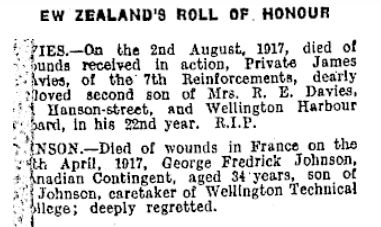
George Frederick Johnson was Gertrude’s brother. The one and the same who went to an orphanage like her and her younger sisters. George had kept in touch with his sisters, through his marriage in 1906, emigration to Calgary, Canada and the birth of his three children. They were proud when he enlisted with the Canadian Infantry in 1915 then devastated when he was killed in France in 1917. Now I had evidence that George Frederick Johnson’s father was the John Johnson acting as caretaker for Wellington Technical College. What was shocking was that John knew of George’s death. Someone had to have told him.
From Elsie Nevill Johnson’s marriage registration we knew that her mother was Mary Ann Gallon. I began to paint a picture of John’s life with Mary Ann the second. When had he arrived in New Zealand? What had he done leading up to his caretaker role?
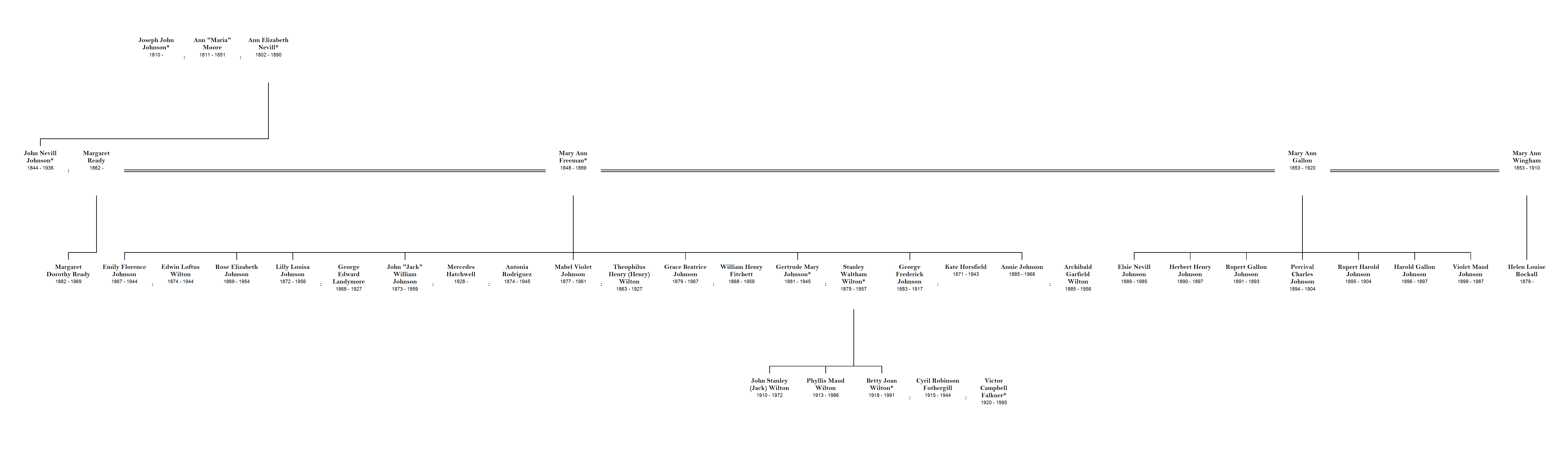
Aside from Elsie, John had fathered six further children with Mary Ann Gallon:
- Herbert Henry Johnson 1890–1897
- Rupert Gallon Johnson 1891–1893
- Percival Charles Johnson 1894–1904
- Rupert Harold Johnson 1895–1904
- Harold Gallon Johnson 1896–1897
- Violet Maud Johnson 1899–1987
All were born during the period that Gertrude and her siblings lost contact with their father. What was interesting was that he had left England very early on, probably before my great-great Grandmother, Mary Ann Freeman, had died.
Tragically, it hadn’t been an easy second life either. Out of the six children, only the two girls made it to adulthood. Rupert Gallon died at 21 months and is buried at Karori Cemetery. Two other sons, Herbert and Harold Gallon, are buried together, also at Karori Cemetery. Percy and Rupert Harold Johnson, drowned in a boating accident in Mangaroa, Upper Hutt, in 1904 and are buried at Akatarawa Cemetery in Wellington.
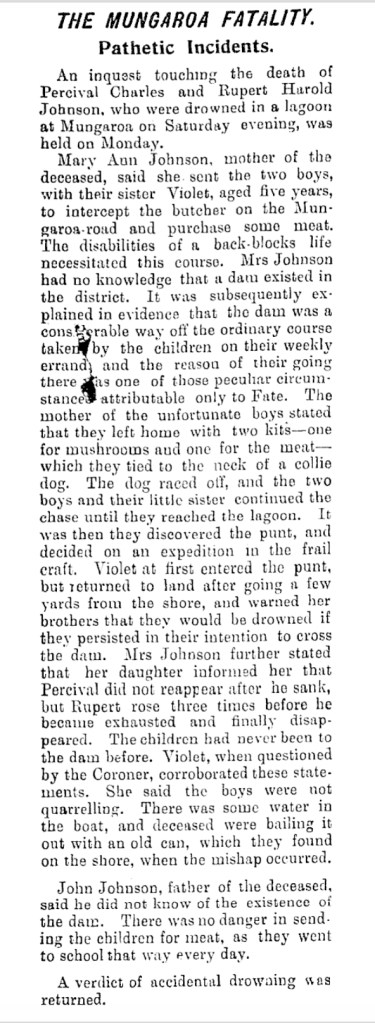
Mary Ann Gallon (John’s second ‘wife’ – to date no marriage registration has been found) died in 1920 in Wellington Hospital. Her death notice stated: “beloved wife of John Johnson, caretaker at Wellington Technical College.”
John was still alive in 1920. It was flabbergasting to think he had actually lived well into the 20th century, rather than dying in the 1880s in poverty in London.
I began ordering possible death printouts based on educated guesses based on a birth date of around 1844. The first wasn’t him. The second, however, was.
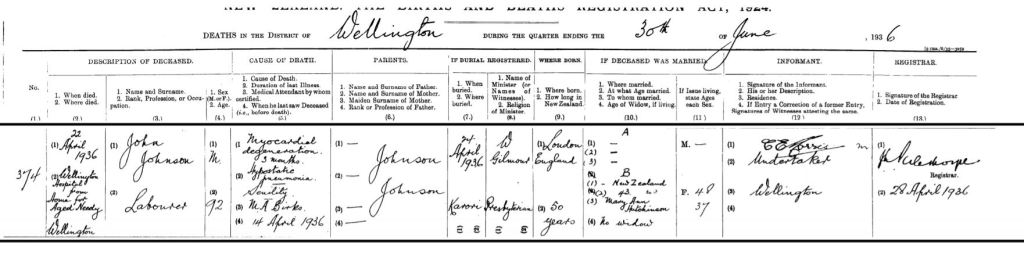
The printout confirmed he had died at Wellington Hospital, where he had been taken from the Home of Aged Needy, in Hospital Rd, Newtown. Although his parents weren’t named, the certificate is only as good as the knowledge of the informant. It is perfectly reasonable to assume neither Elsie or Violet knew who their father’s real parents were, particularly if he had a past he was trying to hide. Born in London, England, John had been in New Zealand for about 50 years, meaning he probably arrived around 1886, a year after his daughter Annie was born in Chelsea and three years before Elsie’s birth. In addition, there was (although no information given) acknowledgement of a previous marriage.
I began to search the newspapers for more information about Gertrude’s sisters. Emily, Lilly, Mabel and Grace had all married and had children. In fact, two of Gertrude’s sisters, Annie and Emily, had married Stanley Waltham Wilton’s brothers, Annie to Archibald Garfield Wilton, Emily to Herbert Henry Lewis Wilton; and Mabel had married a cousin, Theophilus Henry Wilton. All except Rose and Jack had emigrated to New Zealand.
Quite quickly, I noticed Mabel’s marriage notice:
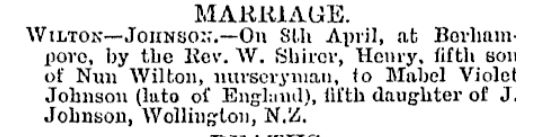
Evening Post, Vol LVII, Iss 88, 15 Apr 1899, Page 6
“Fifth daughter of J. Johnson, Wellington, N.Z.”. Had no one in my family branch ever noticed this before?
I re-examined Mabel’s children. Her first child was named Evelyn Dorothy Neville [sic] Wilton. The Neville middle name had to be a tribute to her Grandmother, surely, despite the slight misspelling.
I messaged one of Lilly’s descendants, informing them of my ‘find’: John had lived a long life after emigrating to New Zealand and even had a second family. They replied: “Oh, that’s where Aunt Vi must fit in”. Lilly had made contact with Violet Maud Johnson, her half-sister, some 20 years younger than her, employing one of Lilly’s daughters in her florist shop in Wellington.
The story of Gertrude seeing her father in Wellington and crossing the street relayed by a cousin now seemed very plausible. I and the other descendants of Gertrude Mary Johnson now had their answer. John was never missing. He was just missing from our narrative. He had run, all the way to Wellington, New Zealand, right where most of his daughters had ended up.
There are still some questions that will never be answered.
We can never truly know why John left his children. Perhaps he became overwhelmed by his obligations (nine children to feed, two illegitimate children, poor job prospects?). He may have intended to retrieve his children from the Workhouses and Orphanages they were sent to, or he may have done what many men did at the time: leave for distant shores and start a new life with a new family. What we can deduce is that he somehow followed their fortunes to some extent. John would not have placed a death notice in 1917 commemorating his son George’s memory if he did not feel something for his first family.
We also will never know if Gertrude knew where her father was. The evidence points to a certain level of knowledge, certainly her elder sisters seemed to know. Perhaps Gertrude, Grace and Annie, the youngest of the nine when he left, never forgave him.
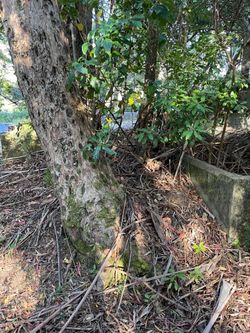
John Nevill Johnson was buried 23 April 1936 at Karori Cemetery, in Wellington, New Zealand. He is in the same plot as Mary Ann Gallon, the mother of his second family of seven children. The grave has no headstone and is overgrown.
I am still looking for a photo of John. If you are a descendant and have one, I would love to hear from you.
 Kinship Genealogy Co.
Leave a comment