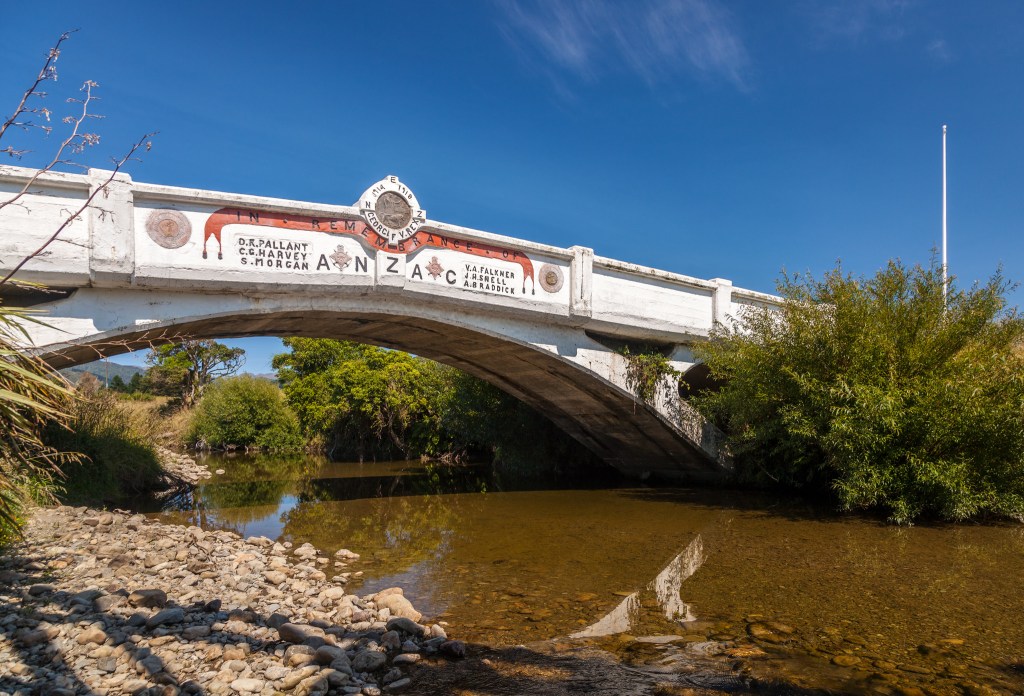
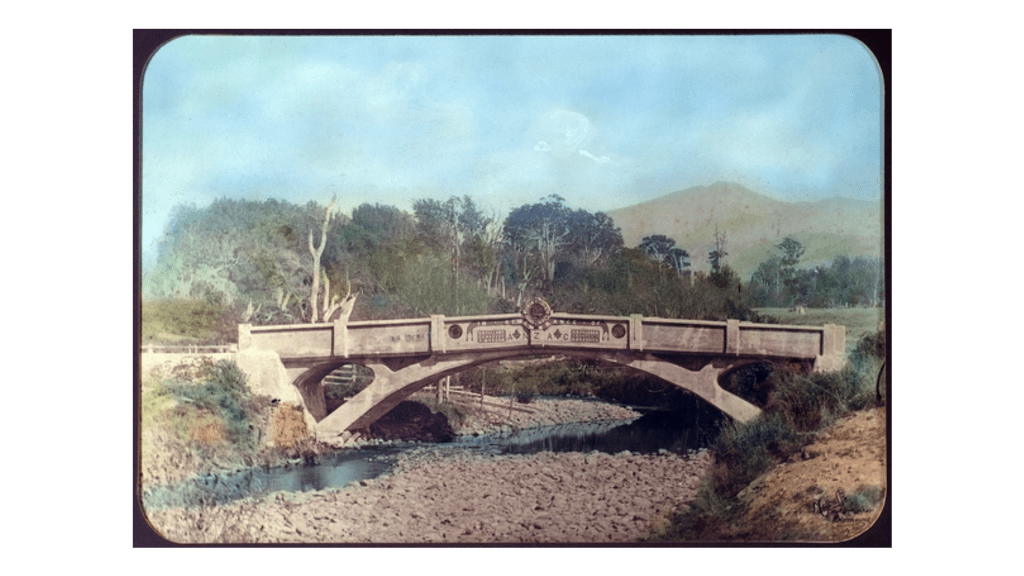
On state Highway 2 south of Eketahuna stands the Anzac Memorial Bridge.
The bridge was built in 1922 by my Great-Great-Grandfather Alfred Falkner, a civil engineer and draughtsman.
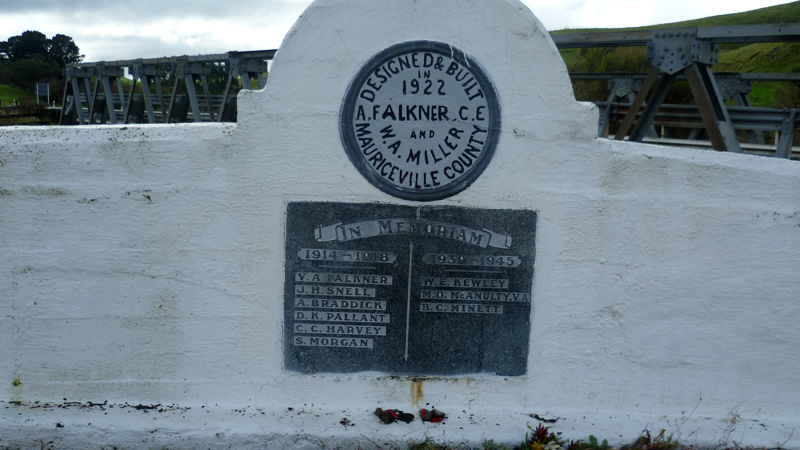
It served as a tribute to his youngest son Victor (21) and nephew Donald Pallant (22) who were both killed at Gallipoli in 1915 and also to remember 4 other sons of the Harvey, Morgan, Snell and Braddick families lost from the Kaiparoro district during WW1.
But how did it come about?
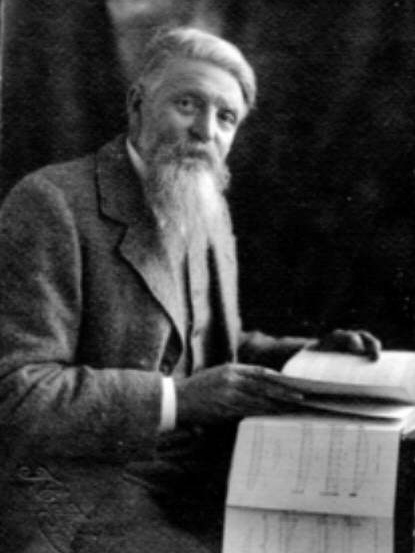
Alfred Ormerod Falkner was born in Leeds, Yorkshire in 1854 to Alexander Falkner and Mary Ormerod. Based upon his drawings, mechanical legacies and family stories, he was artistic yet scientific and bright. Talented, obsessive and a perfectionist, he was quite possibly difficult to live with (his wife left him in 1919 when she was 63 – maybe she had finally had enough!)
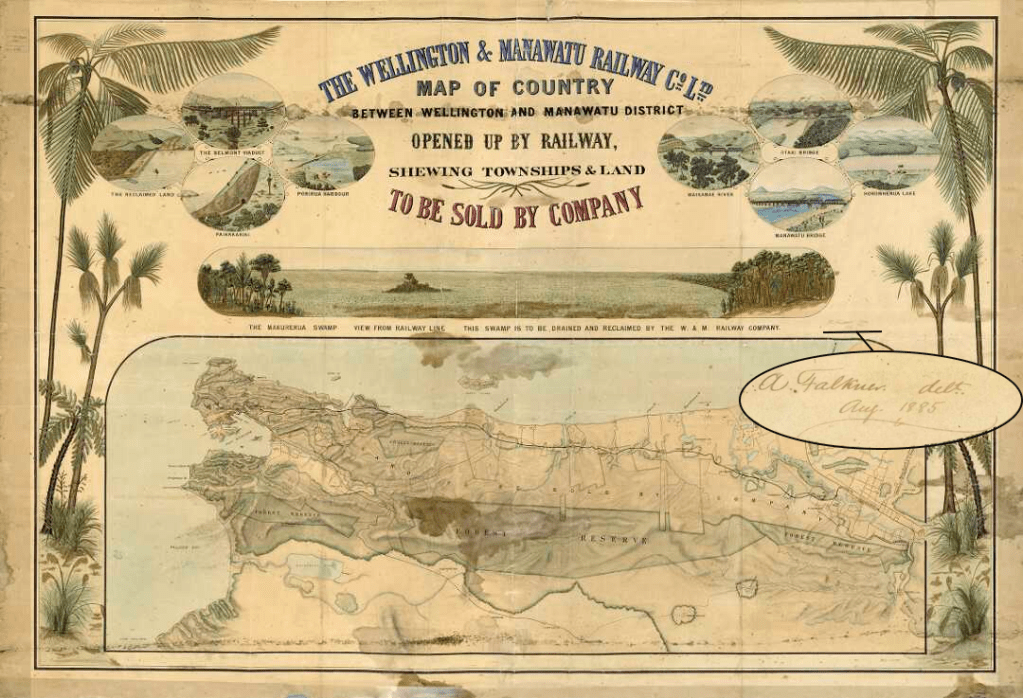
Alfred was educated at Bramham College, Yorkshire and at the Liverpool Technical College. He entered the services of Cammell and Co. and left there as a first mechanical engineer. He emigrated to New Zealand via Australia in 1877 with his younger brother Victor. While Victor stayed on in Melbourne, Alfred continued to Wellington. Within a short time of landing, he met and married Eliza Pallant at the home of her brother in Turnbull Street. He worked as a draughtsman, cartographer and artist for the New Zealand Department of Lands and Survey and then for the Wellington and Manawatu Railway Company designing the rail line. His drawings were works of art.
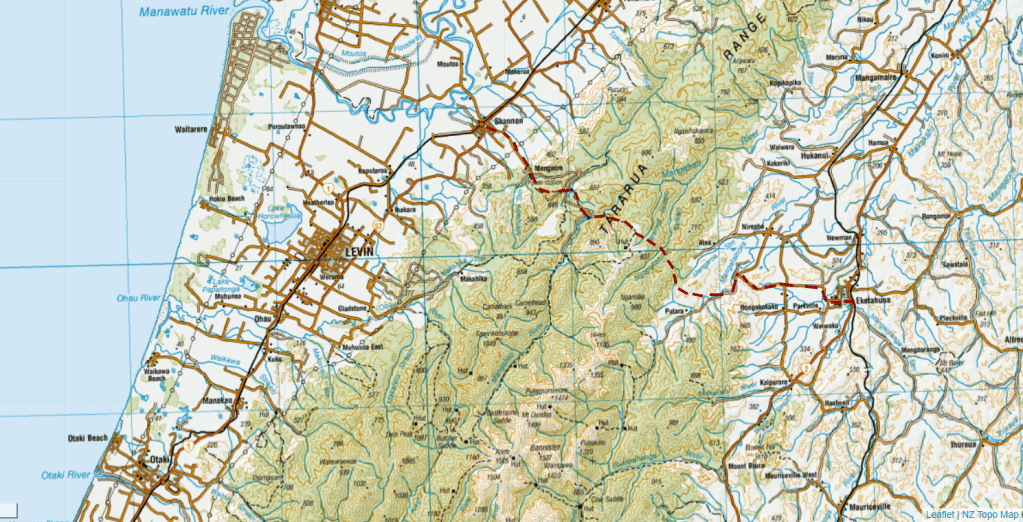
He was also a bit of an intrepid explorer. As part of his work for the Wellington and Manawatu Railway Company, in company with two other officers, he trekked from Shannon to Putara. At this time the country was charted as unknown on the survey maps. The party left with one day’s rations, thinking the trip would be a comparatively easy one. The trip actually took two full days. Until they reached the Mangahao the going was comparatively easy, but from there the travelling was most difficult, with high ridges and leatherwood scrub, which was almost impassable. So close was the mat that a bulldog with the party had to be carried. Finally they reached the Mangatainoka and after some travelling struck a whare, later coming on into Eketahuna.
In 1890, Alfred applied for and was granted land near Eketahuna, in the Forty-Mile Bush area. The settler government of the time wanted to get rid of this bush – to clear areas for farming and settlement. Alfred was clearly familiar with the land due to his previous work surveying. Although still a draughtsman, he applied himself to the hard work of clearing what was dense bush and farming. All while helping to raise twelve children.
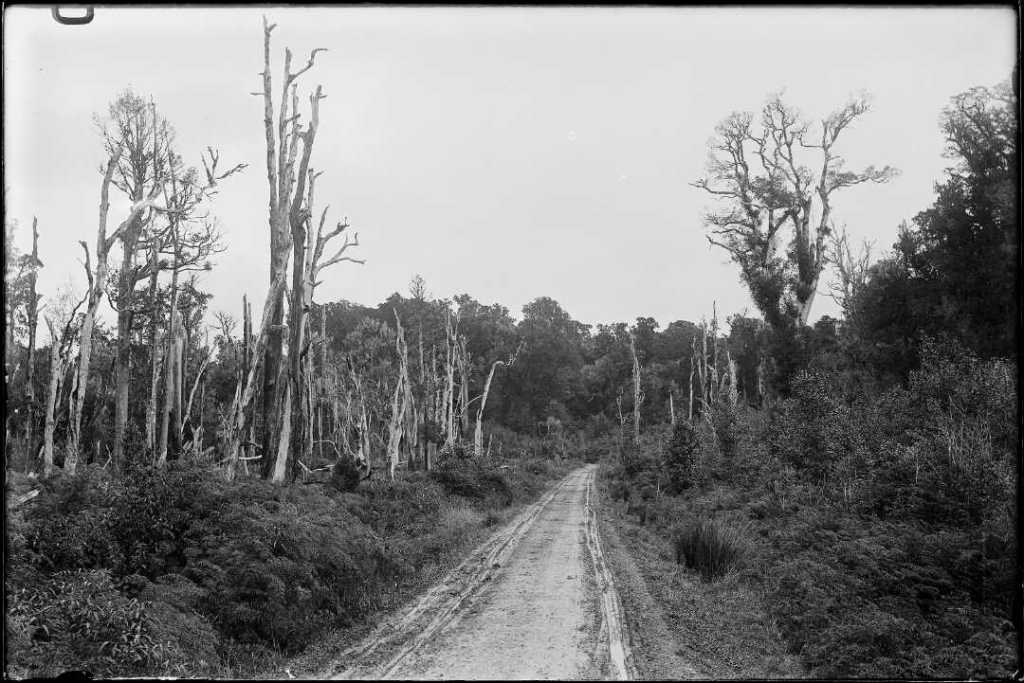
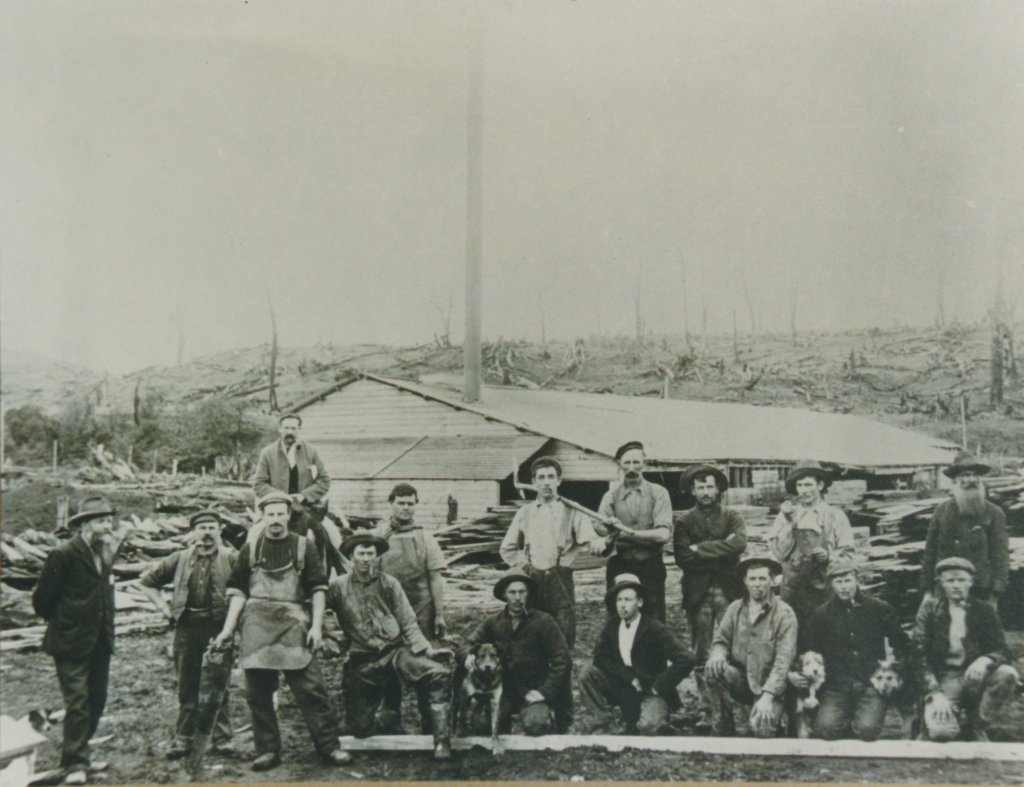
1/1-025950-G
Capitalising on the huge number of trees which needed clearing, about 1895 Alfred established a sawmill on the property and opened a timber yard on the corner of Victoria and Taranaki Streets in Wellington, to process the timber for sale. The yard operated until about 1901 and the sawmill was destroyed by fire in 1906.
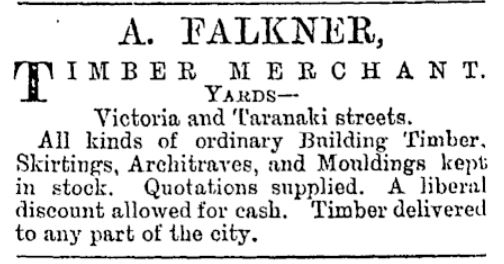
In 1904 he applied for and was granted a patent for “an improved manner of forming moulding boards to adapt them for use in raised panel and square turned work.”
You could say Alfred had a bit of an obsession with bridges. Three scrapbooks in the Ian Matheson Community Archives at Palmerston North Library are full of notes, sketches and newspaper cuttings, mainly concerning bridges and bridge construction in New Zealand, many in the lower North Island, as well as postcards and pictures of bridges and railways from around the world.
The main road north from Masterton had always gone through Mauriceville but in 1905 a suspension bridge was constructed over the upper Ruamahanga River at the foot of Mount Bruce and the western route became the more favoured.
The Makakahi River was a problem for travellers at Kaiparoro. Although not a difficult stream to ford in dry weather, when rain fell in the foothills of the Tararua Ranges, the river quickly filled and crossing the ford became dangerous.
After the loss of a bridge in 1907, Alfred and some of his neighbours, erected a temporary footbridge over the Makakahi river on the Mt. Bruce-road, pending the construction of a proper road bridge for wheel traffic. The footbridge was to be used by local school children.
In 1908 and 1909 he applied for two more patents: “a method for improved construction of a suspension bridge” and an “improved actuating gear for jacks, cranes and like devices“.
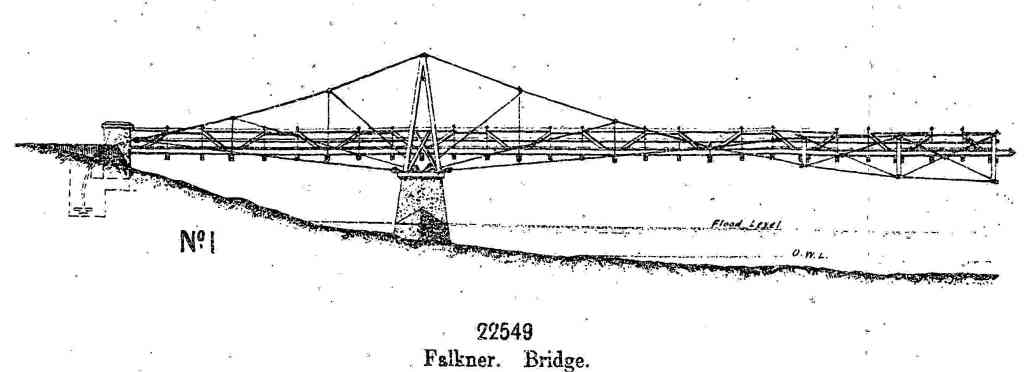
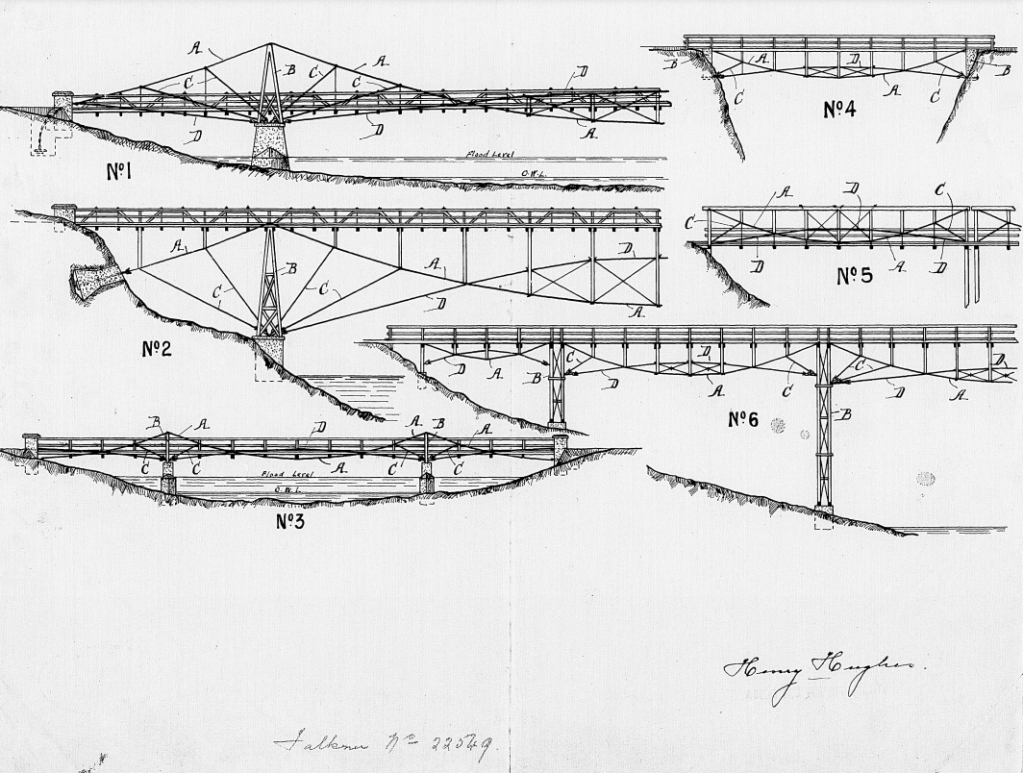
By 1911 he was milling again as well as designing – Alfred was Chief Engineer for the Kaiwara bridge over the Hurunui river in Canterbury, which used his freshly patented suspension idea.
In 1913, Alfred was involved in designing the water supply system for Eketahuna.
In 1914, war broke out. Alfred’s son Victor Andrew Falkner enlisted that December, aged 21. Victor had attended Kaiparoro School, worked in his father’s mill and briefly worked as a farmhand at Opotiki. He was killed at Gallipoli within a year; his body never found. Alfred’s nephew and Victor’s cousin Donald Pallant’s parents lived at Kaiparoro also, but he went to Palmerston North Boys’ High School before becoming a teacher in Wellington and enslisting a few months before Victor. He was also never found.
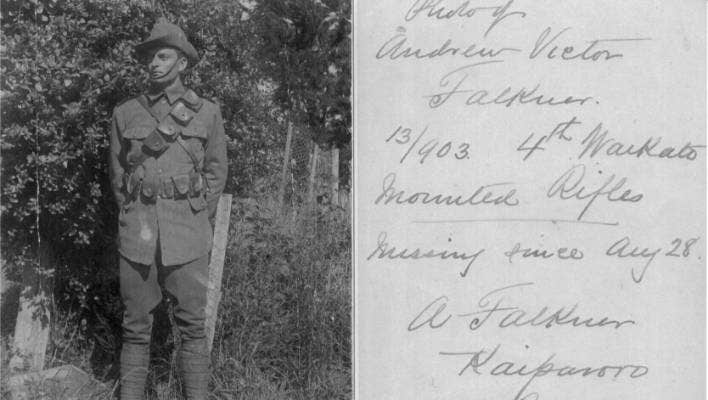
For Alfred, the loss of his youngest son and then his nephew was devastating. Ever-practical, he turned his attention to helping Kaiparoro locals lobby the government for a new bridge. By 1917 the foot passenger-only swing bridge was unsafe and children were going to soon be unable to attend school. The M.P. for Kaiparoro, Mr G.R. Sykes visited in November 1917 and locals begged him to address the state of the river, which was described as a sort of “no-man’s-land”, being situated between the boroughs of Mauriceville and Eketahuna. Locals tried to impress upon Sykes the importance of a bridge which could also take wheeled traffic, and that it would become a semi-arterial route. Being unfamiliar with the area, Sykes was reluctant to support the idea. His engineers had produced an unfavourable report. A committee was formed, of which Alfred was a member, in order to assess what rating would be required for the bridge and do any preliminary work before approaching the local councils.
In September 1917 his son Richard enlisted in Woodville as part of C Company 34th Reinforcements sailing for France in early 1918. How it must have felt to lose a son to war and then farewell another to fight for the same cause is almost impossible to imagine.
Son Richard did return in 1919, however he was never the same (Alfred left £100 per year from his estate to Richard who he described as a “mental defective who has resided with me for many years.”)
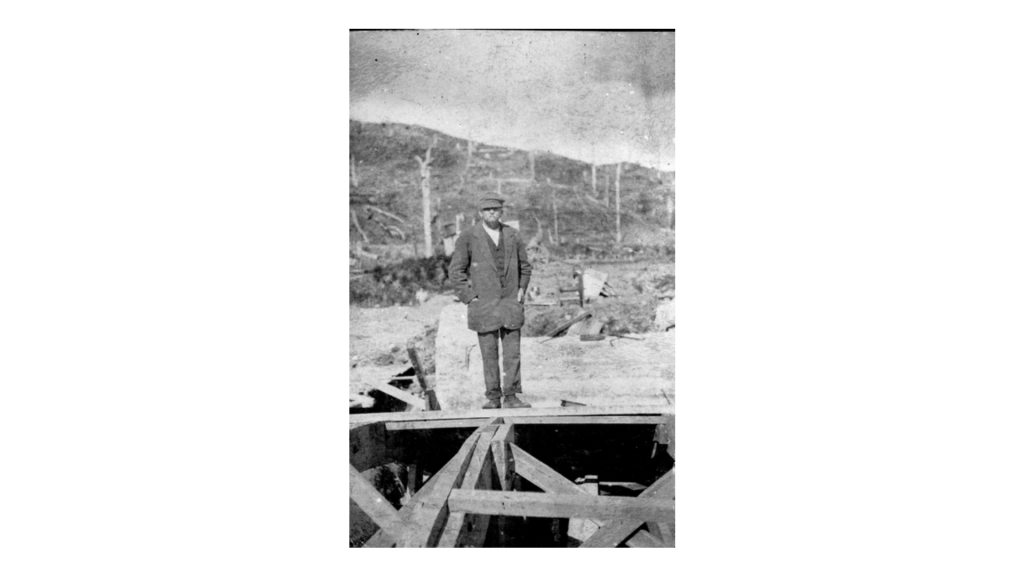
In 1920 he travelled to Auckland and copied blueprints of the Grafton Bridge to scale and set about with locals, some returned soldiers, to build the bridge across the Makakahi River. The Bridge was a practical solution to replace a dangerous ford and old foot bridge, the one he had helped to build in 1907. His plans were forwarded to the Mauriceville County Council who considered it a “graceful…less costly and far more durable” than the wooden bridge designed by the Public Works Department.
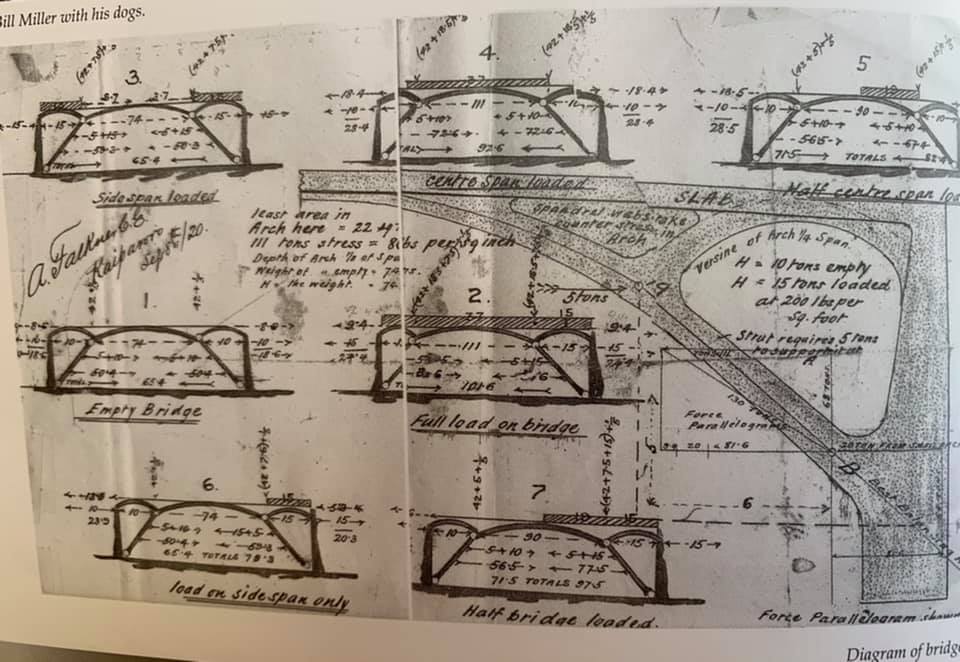
In July, the Mauriceville Council appointed Cr. Miller and Alfred Falkner as a deputation to meet the Minister of Public Works about the alternate bridge plan and suggested to the Eketahuna County Council that it also send a deputation, as, “should Mr Falkner’s plan be adopted, a considerable reduction in the cost of the bridge will result.” It was not to be accepted without a fight, however. In November 1917, the Engineer-in-Chief, Public Works Department, wrote objecting to Alfred’s proposed concrete bridge at Kaiparoro. In his opinion, it would not give sufficient clearance for the timber brought down in high floods. Cr. Miller and Alfred Falkner successfully rebuffed his concerns. Being long-time residents of the area, they had ensured ample clearance had been allowed in their design.
After persistent lobbying, the estimated cost of £1000 was met by grants from the government, Mauriceville County, Eketahuna County and Eketahuna Borough. By using local labour Falkner managed a final cost of only £800.
In May 1922 it was announced that the bridge was to be made into a War Memorial. As an additional personal touch, Alfred had a hand in making the plaque on the bridge. Based upon the 1914-15 King’s War Medal, Alfred created the moulds and casts of the plaque himself, presumably using his son Andrew’s medals as a guide.
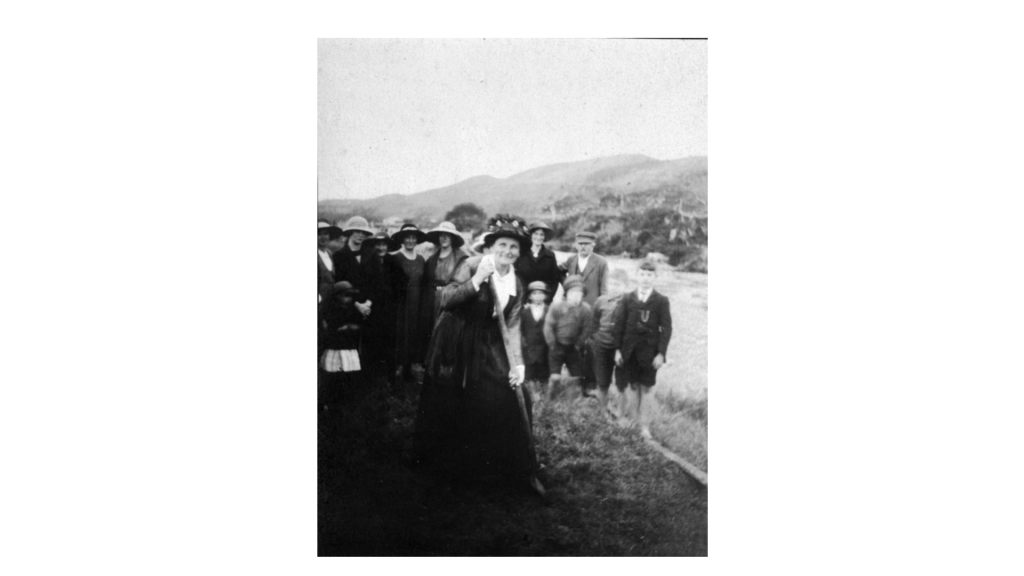
The Bridge was opened December 1st 1922, with the memorial tablet being unveiled on ANZAC Day 1923.
Alfred continued to farm in Kaiparoro until his death in 1939. He is buried at the Eketahuna Mangaoranga Cemetery.
As for the Kaiparoro bridge, a new one replaced it in 1956. After being set for destruction, the old bridge was thankfully saved by locals from the district and descendants of those named on the bridge. After much work and commitment the Bridge has been restored and Anzac services held there since 2006.
In 2022, the Kaiparoro Bridge commemorated its 100-year anniversary.
The centenary event, attended by 150 people and organised by the Friends of the Anzac Bridge (FOAB), featured a re-enactment of the bridge’s 1922 opening ceremony. MP Kieran McAnulty (a relative of Private Margret Olive McAnulty, memorialised on the bridge – and also by marriage to the Falkners) delivered George Sykes’ original speech, and drove over the bridge in a 1920s Buick. The ribbon was cut by (the original cutter Mary Hansen’s granddaughter) Fay Paku – with the same sterling silver scissors her grandmother used in 1922, which had been kept as a family heirloom.
The ceremony was followed by the launch of local history book Anzac Memorial Bridge: A Century of Service, compiled by FOAB secretary and treasurer Glenys E Hansen, at the Eketāhuna Community Centre.
Acknowledgements:
Hayley (Falkner) Grant, cousin and fellow genealogy enthusiast 🙂
PERSONAL. Manawatu Standard, Vol LIX, Iss 168, 17 Jun 1939, Page 10
SAWMILL DESTROYED BY FIRE. Wairarapa Age, Vol XXVIX, Iss 8149, 25 May 1906, Page 6
CHEAP BRIDGES. Timaru Herald, Vol XCIV, Iss 14445, 17 May 1911, Page 3
LOCAL AND GENERAL. Wairarapa Daily Times, Vol 43, Iss 133035, 30 Aug 1917, Page 4
KAIPARORO NOTES. Wairarapa Daily Times, Vol 43, Issue 13406, 24 Nov 1917, Page 5
MAURICEVILLE COUNTY COUNCIL. Wairarapa Age, 28 Apr 1920, Page 7
MAURICEVILLE COUNTY COUNCIL. Wairarapa Age, 1 Jul 1920, Page 7
MAURICEVILLE COUNTY COUNCIL. Wairarapa Age, 3 Nov 1920, Page 7
THE SHANNON NEWS. Shannon News, 14 Feb 1922, Page 2
LOCAL AND GENERAL. Wairarapa Daily Times, Vol 48, Iss 14658, 12 May 1922, Page 4
LOCAL AND GENERAL. Wairarapa Daily Times, Vol 49, Iss 14907, 24 April 1923, Page 4
New Zealand’s First World War Heritage / Imelda Bargas, Tim Shoebridge. Exisle Publishing Limited, 2015
The settling of Eketāhuna / Museum of New Zealand Te Papa Tongarewa
WW100 – Wairarapa’s First World War Centenary
ANZAC Memorial Bridge / Masterton District Library
Anzac Bridge guardians honoured / Erin Kavanagh-Hall. NZ Herald 13 Oct 2015
Bridging. Dominion Post 25 Apr 2016
Patent Case Search / Intellectual Property Office of New Zealand
Wairarapa community honours settlers’ sacrifice in Gallipoli and France through unique Anzac bridge / Caleb Harris. Stuff, Apr 24 2016
Flavell, Kay. Living in Kaiparoro: Stories of a Tararua Community And Its Anzac Memorial Bridge. New Pacific Studio, 2008
“New Zealand, Archives New Zealand, Probate Records, 1843-1998,” database with images, FamilySearch (https://familysearch.org/ark:/61903/3:1:3QS7-89MF-47C6?cc=1865481&wc=4BD7-WJ1%3A1045247601%2C1045322001), Masterton Court > Probate records 1939 P1114-P1155 > image 355 of 579; Archives New Zealand, Auckland Regional Office.
Are you a Falkner relative? Or a descendant of a Kaiparoro settler? If you have any more information please comment!
 Kinship Genealogy Co.
Leave a comment