Most of us who are interested in genealogy will have noticed that our ancestors had unusually large families. There were many reasons for this: little knowledge about reproduction; societal attitudes to discussing birth control; large families were a source of pride and a sign of virility; children were seen as economically-useful assets; and high child mortality rates often led families to compensate by having as many children as possible.
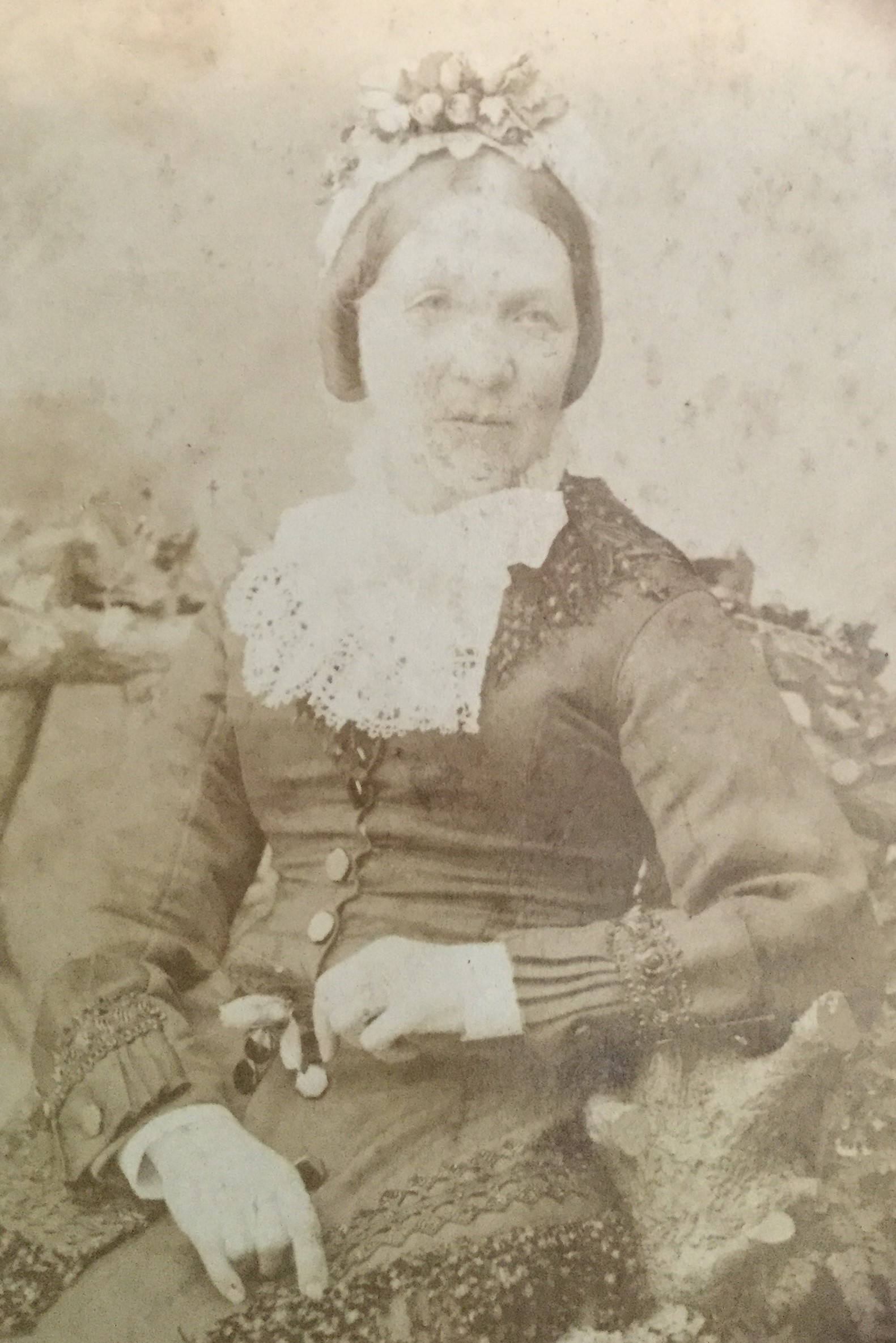
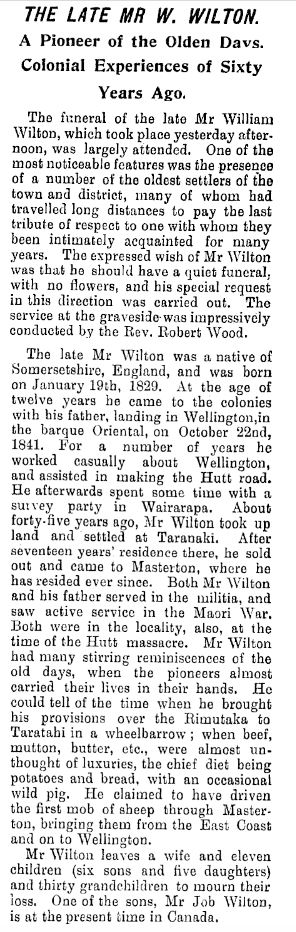
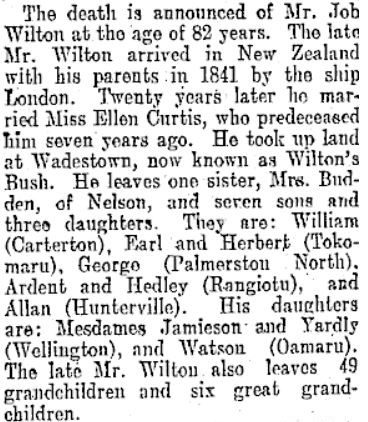
One particularly fertile couple stands out amongst all of my researched ancestors: Robert Wilton and Elizabeth Denman. Robert and Elizabeth are my third great-grandparents, emigrating to Wellington, New Zealand from Yeovil, Somerset, England in 1841 on the ‘Oriental.’ Some researchers say they had up to 19 children (however, I have managed to document only 12) between 1822-1850.
What makes this couple so unique is not just their number of children. Large families were common amongst New Zealand settlers. It is that each of their surviving sons (of which there were 7) had at least 10 children each, leading to an unequalled number of descendants compared to my other ancestors. My own line, that of Henry and Hannah Wilton, comes in at 11 children. Robert and Elizabeth’s daughters, Frances, Charlotte and Amy, had 5, 8 and 6 offspring respectively, Frances’ child-bearing years cut short due to her death at the age of 31, and similarly, Charlotte’s, dying at 42 years of a “long and protracted illness.”
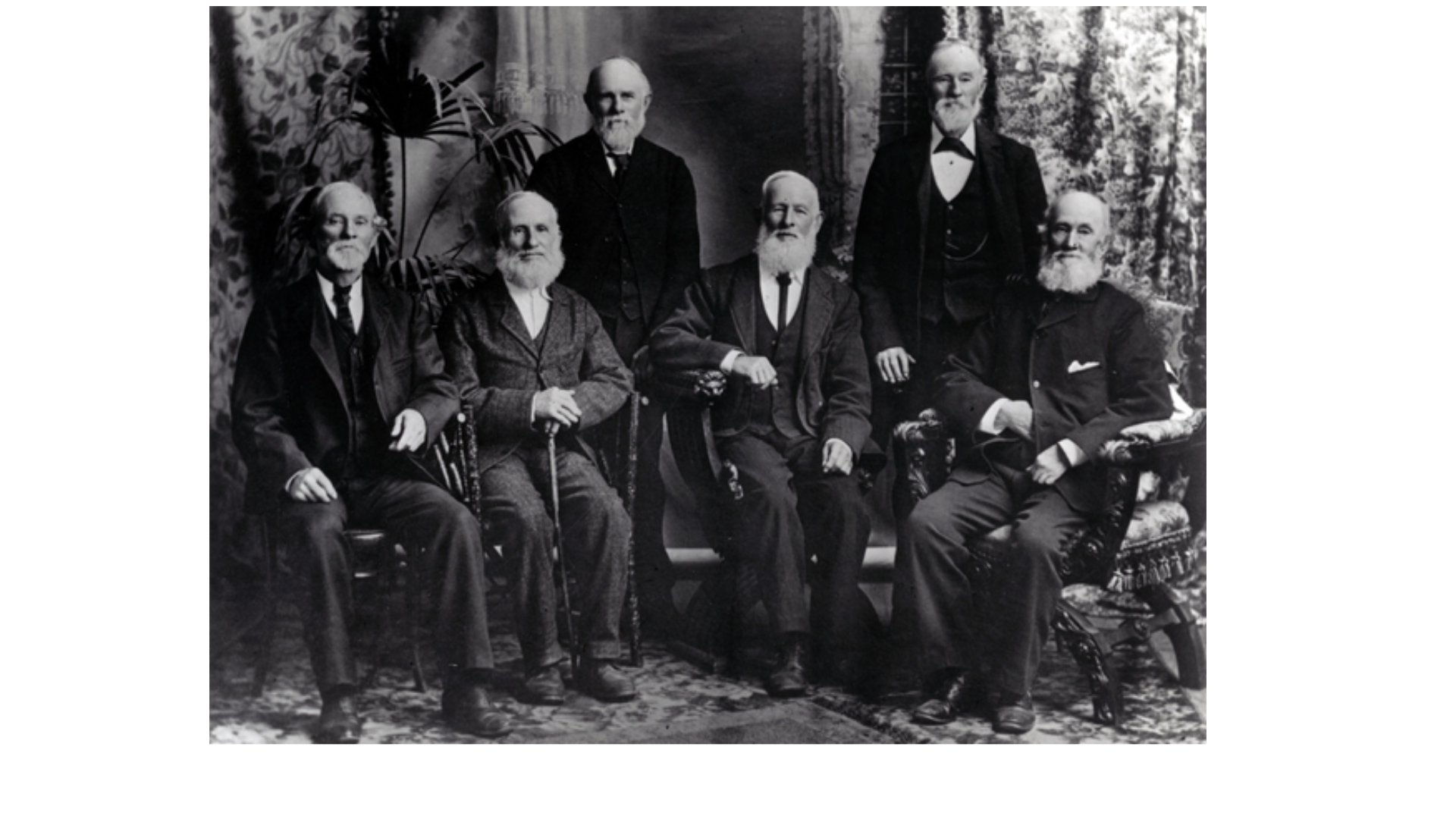
Henry Budden, husband of Amy Wilton (and the only daughter of Robert and Elizabeth to live a long life) attempted to collate some data on the Wilton family in 1902, believing them to be “the largest family in the colony.” His death delayed the results, but son Urban Wilton Budden took on the task and estimated no less than 477 descendants “related to each other at present” from the original couple. By 1975, there were said to be 15,000 descendants in New Zealand. It is not too conservative to estimate that there are probably at least 25,000 today!
DNA-wise, Wilton descendants dominate my family’s DNA matches. It is a prime example of just how many of their offspring there are! Additionally, our line of Wiltons is also affected by something called pedigree collapse. Pedigree collapse occurs when two relatives reproduce, causing their descendants to have the same ancestor(s) occupy more than one position in their family tree. It can make genetic genealogy a bit more challenging. It is not as easy to identify who the common ancestor is that is shared between two DNA testers. Where the Wiltons are concerned, matches may share multiple relationships and there may not be only one common ancestor. Drawing assumptions about possible common ancestors based on the amount of shared DNA between two matches, doesn’t work using the usual tools either (such as cM calculators) as the shared DNA is often misleadingly high.
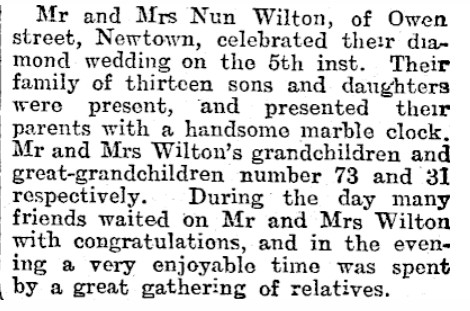
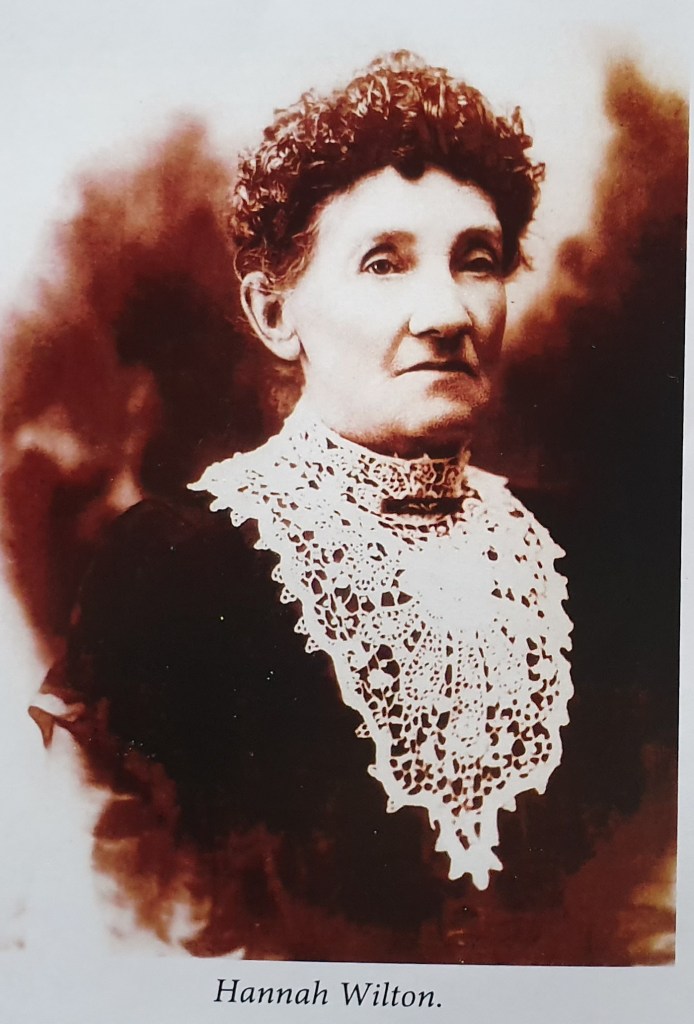
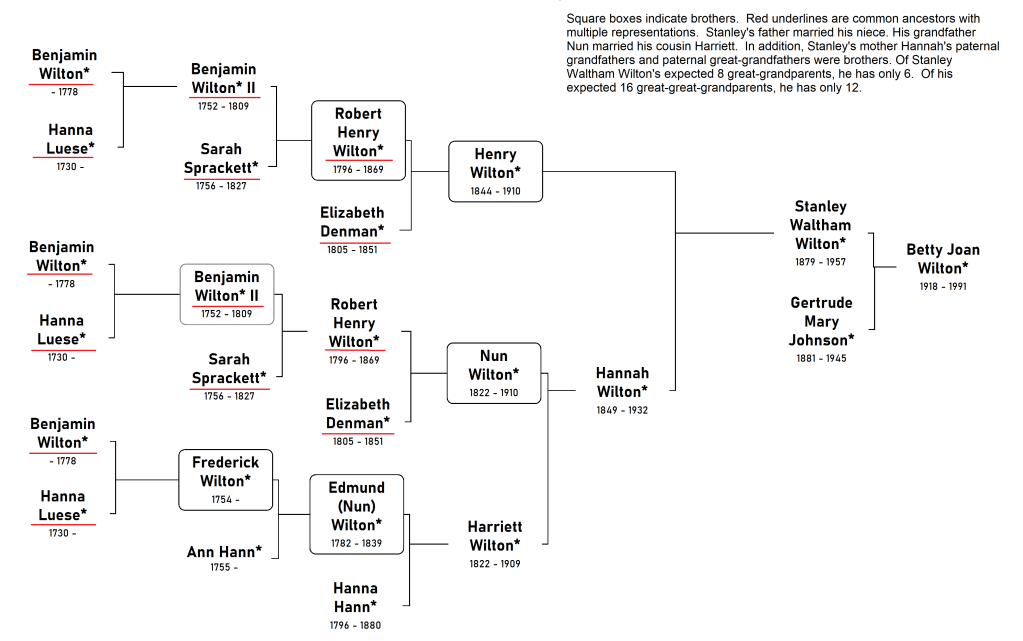
In this case, Robert and Elizabeth (Denman) Wilton’s son Nun married his cousin Harriett. Making things worse, Harriett’s daughter Hannah then married her Uncle Henry (yes, you read that right!). Henry Wilton, Hannah’s husband, was Nun’s youngest brother. To be fair, Hannah and Henry were the same age. Henry was New Zealand-born, while Hannah was English-born, arriving in New Zealand in 1858 at the age of 9. In addition, Hannah’s paternal grandparents were also her in-laws, two of her great-grandparents were brothers and she and her husband shared great and great-great grandparents, Benjamin Wilton and Hanna Luese.
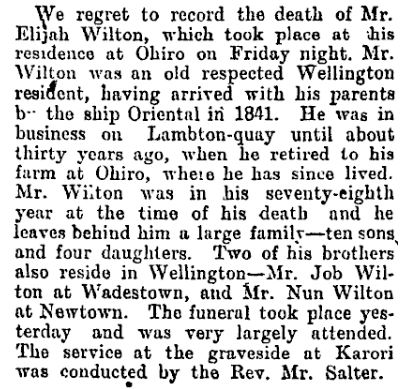
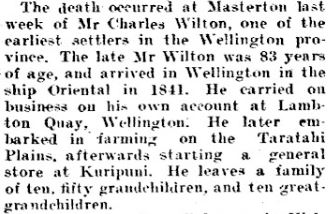
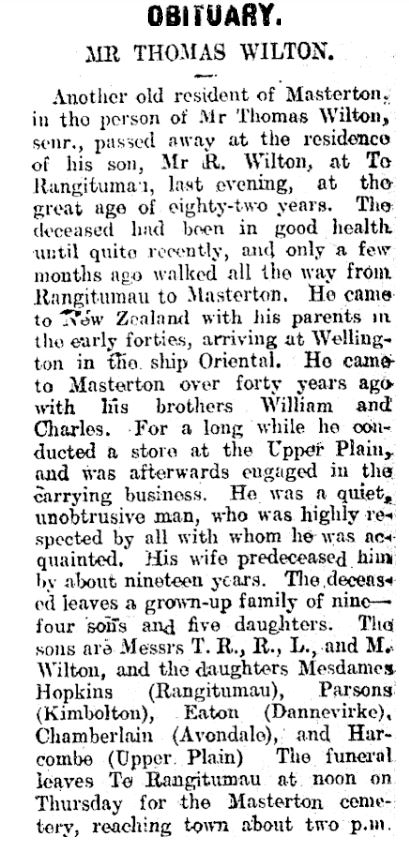
Here is a visual representation of pedigree collapse amongst the Wilton line. At first glance, this looks like a normal pedigree. Using my maternal great-grandfather Stanley Waltham Wilton, to the right of the tree, as an example, you can clearly see those ancestors who appear more than once underlined in red, with brothers placed in black boxes. Stanley’s mother Hannah is of a different generation altogether than his father. While most people have 8 great-grandparents, Stanley had only 6. Where most people have 16 great-great-grandparents, Stanley had only 12. Here, the red underlining makes the degree of collapse more apparent.
So what does this mean for Wilton researchers, especially DNA researchers? Sometimes, a bit more research is needed in order to identify the exact relationship to ourselves. Due to the sheer number of offspring of Robert Wilton and Elizabeth Denman, huge numbers of Wiltons feature in my family’s DNA match lists. Generally we share much more DNA with other Wilton descendants than we would reasonably expect for cousins.
Are you descendant of Robert Wilton and Elizabeth Denman? Were you aware of the close relationships amongst New Zealand descendants? How many of your ancestors appear more than once in your tree? Did you know this was called pedigree collapse? I'd love to know.
Sources:
Pooley S. “Parenthood, child-rearing and fertility in England, 1850-1914,” History of the Family, 2013 Mar; 18 (1), p.83-106. Published online 2013 May <https://www.ncbi.nlm.nih.gov/pmc/articles/PMC3865739>
Meehan, Elizabeth. “Population Growth Rate & Examples,” Alberta Education Diploma: Biology 30: Exam Prep & Study Guide – Population Change in Biology. Last updated online at Study.com 20 Dec 2021 <https://study.com/academy/lesson/population-growth-rate-definition-formula-examples.html>
Dyer, Nicole. “The Effect of Pedigree Collapse on DNA Matching: A Case Study,” blogpost, Family Locket <https://familylocket.com/the-effect-of-pedigree-collapse-on-dna-matching-a-case-study : posted 6 Nov 2022>
Wilton, Jo. Wiltons galore : the pioneer story of Robert Wilton and Elizabeth Denman from Montacute, Somerset, England to their children and grandchildren in New Zealand.
Wellington, N.Z. : Watson & Liddell, 2007.
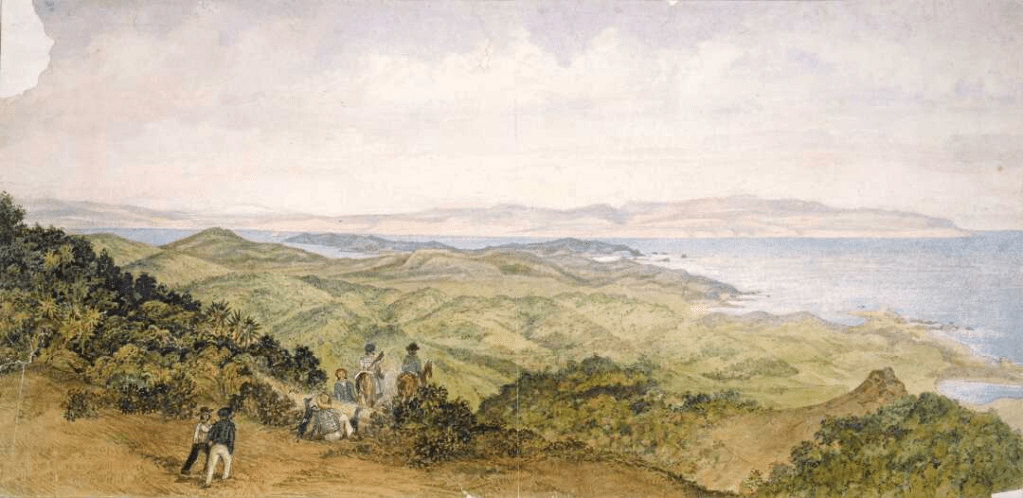
Post main image: Brees, Samuel Charles, 1810?-1865. [Brees, Samuel Charles] 1810-1865 :View of Port Nicholson from the range of hills west of the Ohiro Valley [ca 1844]. Ref: C-126-002. Alexander Turnbull Library, Wellington, New Zealand. /records/22666452. View looking north-east along Wellington’s south coast from above Ohiro Bay, past Island Bay and towards the Harbour entrance. The Ohiro Valley is where Robert Wilton leased and bought 169 acres of land in 1865 and where he died in 1869.
Disclaimer: I am not a mathmetician by any means, so please feel free to correct me on my descendant estimates!
 Kinship Genealogy Co.
Leave a comment